
A reference page on heat as a training load: why a warm day lifts your heart rate at an unchanged pace, what one to two weeks of heat exposure change in the body, how quickly that fades again, what a sauna after training adds, and the core temperature at which exercise ends on its own.
It does in the heat, and reliably. Repeated exercise in warm conditions over one to two weeks lowers the heart rate and the core temperature you work at and gets you sweating sooner. For performance in cool weather the honest answer is maybe: some well-controlled studies find a gain there and others find none at all. A sauna after training looks like a smaller dose of the same stimulus. What none of this offers is a way to train past the temperature at which the body ends the work for you.
This is part four of the Ironman series. Part three was about lactate, and it found that the threshold people train against behaves more like a reading than a wall; this page is about a load that never appears on a training screen in the first place. Part five returns to VO2 max, the figure part one told you not to race by, and asks what it means for ageing. The Substack essay is the shorter telling; this page adds the studies, their limits and the sources.
Key points
-
At an unchanged pace, heart rate creeps upward over a long session, far more so in warm air, while your ceiling for oxygen uptake drops, so the session is harder than the pace suggests.
-
Training in warm conditions for one to two weeks brings most of its adaptation in the first week: a lower heart rate and core temperature at the same work, earlier sweating, more plasma.
-
The gain shows reliably when the test is hot. In the cool, careful studies disagree.
-
About half an hour of sauna after training, three sessions a week over three weeks, improved heat tolerance and some markers of capacity in trained runners, and a hot bath after exercise produced heat acclimation too.
-
Without further heat, each day erases roughly 2.5 percent of what was gained in heart rate and core temperature, and rebuilding it is much quicker than losing it.
-
In seven trained cyclists, riding in the heat ended at the same core temperature whatever the starting point. Willpower didn't move it.
This is an educational and strategic perspective, not personal medical advice.
The views are the author's own and not statements by Atlas Cove Lda.
Why your heart rate climbs at the same pace in the heat
Ride or run steadily for an hour, hold the power or the pace constant, and look at the heart rate trace afterwards. For the first ten to twenty minutes it behaves. Then it starts to creep up and carries on creeping for the rest of the session, while the output stays exactly where you put it. Physiologists call this cardiovascular drift, and the part everyone agrees on is that the heart moves less blood with each beat as the session goes on, so it has to beat more often to keep the total delivery the same (Coyle and González-Alonso, 2001). In cool air the creep is small. In warm air it's large enough to rewrite the session.
Why the stroke shrinks is argued. The older explanation is thermal: blood is sent out to the skin so heat can leave the body, a share of it pools there, and less of it comes back to fill the heart. Coyle and González-Alonso put the steps in the opposite order. As body temperature rises, the heart speeds up first; at that tempo there is less time to refill between beats, and the stroke shrinks mainly for that reason (Coyle and González-Alonso, 2001). I find their version more convincing, and I'd still call it a version. Losing fluid pushes the same way. The heat consensus of 2015 is clear that dehydration during exercise in the heat adds to both the heat strain and the strain on the circulation (Racinais et al., 2015).
What matters more is where both camps agree. Wingo and colleagues point out that while drift is under way in the heat, maximal oxygen uptake drops too, so the same absolute pace takes a bigger slice of what you can actually do at that moment (Wingo et al., 2012). The rising number is honest. A heart rate that climbs at a steady pace on a warm day is reporting a harder session, and it's reporting it correctly.
A training watch stores pace, distance and pulse. It usually leaves out the air temperature, so a warm afternoon lands in the log as a slower run at a higher heart rate and reads as lost fitness, after which people either train harder or start to worry, and neither of those answers a load nobody counted. I've written about which wearable scores are accurate and which are guesses; heat is the plainest case of a number the display never had to begin with.
At my Ironman in Cascais on 18 October 2025, over the full distance, my chest strap averaged 143 in the swim, 142 on the bike and 144 on the run, and across eleven hours the three sat within two beats of each other. Without the day's weather beside it, a trace that flat looks mechanical. The same 142 on a bike means one thing in April and something quite different on a hot afternoon, and further down I'll say which day this was.
In summer I train in the heat on purpose, in Portugal and in Germany, sometimes at the hottest hour, because I want the load, and it shows up exactly where physiology predicts, in my heart rate and my sweat, with direct sun adding its own share. I can't name a hot session I'd call a mistake. Some I ran slower, a few I paused, and those count among the good ones, because easing off when the load asks for it is part of training in heat.
What one to two weeks of heat exposure change
Heat behaves like any stimulus that's repeated often enough, and the body adapts to it quickly. The consensus statement recommends repeated exercise in the heat spread across one to two weeks, reports that most of the change arrives in the first week and the remainder more slowly over the following two, notes that highly trained athletes can get there in as little as half the time untrained people need, and puts near complete adaptation of the heart and of sweating at six to ten days (Racinais et al., 2015).
The same document names what changes. You start sweating more readily, more blood reaches the skin, plasma volume expands, the circulation holds blood pressure and cardiac output more steadily, and the balance of fluid and salt improves (Racinais et al., 2015). The review by Périard, Racinais and Sawka adds lower body temperatures and less strain on the heart to that list, and it names four things that decide how big the change is: how intense, how long, how often and how many the heat exposures are (Périard et al., 2015). One line in the consensus deserves more attention than it gets. Ordinary training in temperate weather gives you a partial heat adaptation, it says, and that can't stand in for consecutive days of training in the heat.
Two studies put numbers on the first items. Lorenzo and colleagues had twelve trained cyclists do ten days of gentle riding, at around half their VO2 max, in a room held at 40 degrees, and their plasma volume went up by 6.5 percent (Lorenzo et al., 2010), which is more fluid coming back to fill the heart and so an answer aimed straight at the cause of drift. Keiser's group trained people for ten days at 38 degrees. Sweat output rose by about a quarter, and the sodium in that sweat fell by about a fifth (Keiser et al., 2015). A better filled heart needs fewer beats.
What these studies can't tell you is which of the changes does the work. In Keiser's crossover none of the adaptations they measured correlated with the change in performance (Keiser et al., 2015), and the consensus notes that the role of the plasma expansion is still debated (Racinais et al., 2015). The list of changes is solid. The causal line from any single one of them to a faster time trial isn't.
Does heat training help in cool weather?
Here the evidence splits, and it's the part I'd hold most loosely. Lorenzo's heat-acclimated riders were also tested in a 13-degree room, where their VO2 max rose by 5 percent and their time-trial work by 6 percent, while eight matched controls who'd done identical training in cool conditions changed on no measure at all (Lorenzo et al., 2010). On that study alone you'd send every endurance athlete into a hot room.
Karlsen and colleagues ran the obvious check, outdoors. Nine well-trained cyclists spent two weeks training at about 35 degrees while nine matched riders trained in cool conditions. In the heat, their time trial got 16 percent better. Outdoors, over 43 kilometres at five to thirteen degrees, they were no faster than before, and their VO2 max hadn't moved (Karlsen et al., 2015). Keiser's seven men, tested in a crossover, show the same shape: better at 38 degrees after heat training, unchanged at 18 (Keiser et al., 2015). Zurawlew's hot-bath study split the same way: a time trial at 33 degrees improved, one at 18 degrees didn't (Zurawlew et al., 2016).
The reviews read this cautiously as well. Périard, Racinais and Sawka write that heat acclimation improves aerobic performance in warm to hot conditions and "potentially" in temperate ones (Périard et al., 2015), and the consensus calls the benefit "more circumstantial" for highly trained athletes who don't need to shed much heat (Racinais et al., 2015). So the dependable return is heat tolerance, worth having for its own sake if you race or spend summers somewhere hot. Any gain for cool days depends on which careful study you read, so I treat it as a possible extra and never as the reason to do the work.
Does sauna after training improve endurance?
A sauna after a session applies the same stimulus in a smaller, more convenient dose, and the research on it has improved. The first controlled study was small. Scoon and colleagues had six male distance runners sit in a humid sauna of close to 90 degrees for roughly half an hour straight after training, on about thirteen occasions over three weeks, against three weeks of normal training in a crossover. Their run to exhaustion lasted 32 percent longer, which the authors themselves convert into roughly 2 percent in an endurance time trial, and plasma volume rose by 7.1 percent (Scoon et al., 2007). Six men and no parallel control group: a promising start, and no more.
Kirby and colleagues ran the better-designed version. Twenty trained middle-distance runners took part, thirteen of them women, and twelve of them added about half an hour of sauna at more than 100 degrees after training, three sessions a week over three weeks, while the other eight didn't. In a heat-tolerance test at the end, their peak heart rate was eleven beats below the controls' and core temperature sat 0.2 degrees below theirs, while cool-room testing showed higher VO2 max and a faster speed at a fixed blood lactate. Carrying on to seven weeks added little to what three had already given (Kirby et al., 2021).
You don't need a sauna for any of this. Zurawlew and colleagues had seventeen men run for 40 minutes in temperate conditions and then get into water, on six days in a row, ten of them into a 40-degree bath for 40 minutes and seven into water at a neutral temperature. The bath group showed classic heat acclimation: a lower core temperature at rest and during exercise, and sweating that started at a lower core temperature. Their 5-kilometre time trial at 33 degrees improved by 4.9 percent (Zurawlew et al., 2016).
That's the core of my quarrel with how saunas get sold, as a ritual with a set temperature, a cold plunge and no stated reason, when the studies test a dose of heat after hard work that a hot bath can deliver too. Heat after a hard session has a known time course. The same half hour because a timetable says so is pleasant, and untested.
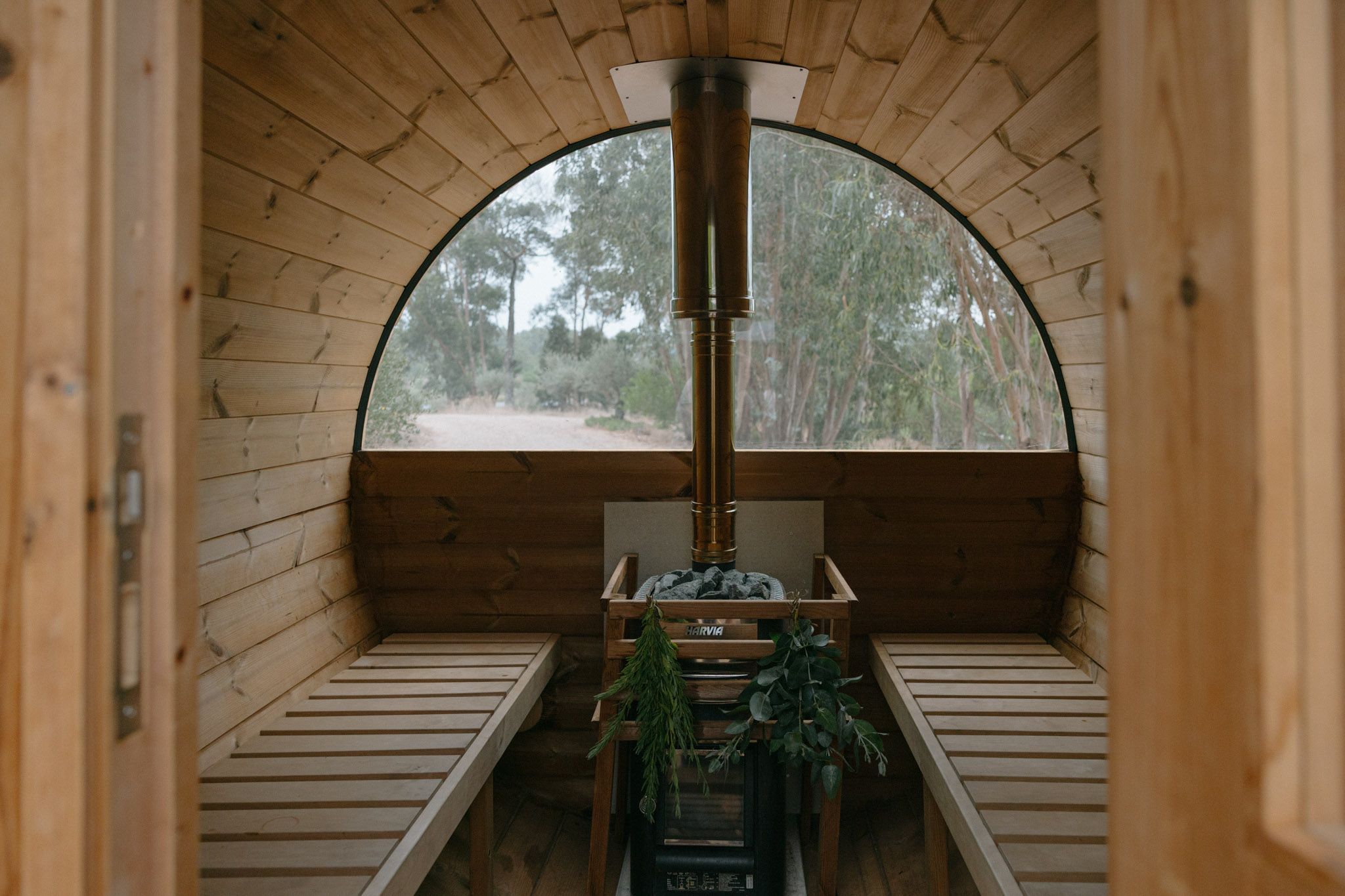
I know this dose as an athlete and as a host. As an athlete I get into a sauna after training when there's one I can reach, which is less often than I'd want. As a host, in the week I ran in September, I put the same half hour on the timetable as a led session. By the end of that week I'd changed my mind. People can dose an afternoon block like that without being led, and the freed hour goes to the kind of conversation that only happens between two people. I wrote about that week in what happens at a six-day longevity retreat.
Why a sauna evening ends quietly
What surprised me that week was the evening. People left the sauna slower and quieter than they'd gone in, and so did I; the feeling lasted until bed and had gone by the morning. A calm evening is exactly what the last part of a day should leave behind, and it's the reason we put the sauna in the afternoon.
The physiology looks a lot like a workout, because in most ways it is one: heat raises skin and core temperature, the hypothalamus switches on heat loss through the autonomic nervous system, and the sympathetic side pushes up heart rate, skin blood flow, cardiac output and sweating (Hussain and Cohen, 2018). The review describes heat stress as a hormetic strain much like exercise, a load the body answers by adapting. You've trained without moving.
Then you step out. The vessels in the skin stay wide, heat keeps leaving, and core temperature drops. A warm bath before bed relies on exactly that drop. Haghayegh and colleagues pooled 13 studies in their meta-analysis and found that warm water on the skin, a bath or a shower between 40 and 42.5 degrees and one to two hours before bedtime, helped people fall asleep sooner, and they point to the drop in core temperature that follows as blood flows out to the hands and feet (Haghayegh et al., 2019).
Those studies measured sleep after bathing. What I saw was a room of people getting quieter after a sauna, so linking the two is my inference, and I'm marking it as one. It fits the mechanism. Nobody has tested it in that setting.
How long does heat acclimation last?
Heat adaptation fades when the heat stops. A meta-analysis by Daanen, Racinais and Périard gathered twelve decay studies and put a rate on it: each day without heat costs about 2.5 percent of the adaptation in heart rate and core temperature (Daanen et al., 2018). In the consensus, the majority of the benefit is expected to last between two and four weeks (Racinais et al., 2015). A heat block in June, left alone, is mostly spent by August.
Five or more days of heat were enough for heart rate and core temperature adaptations that held steadily, and longer exposures on each day of heat made the core temperature adaptation last longer. Sweating behaved differently. Its decay didn't track the number of days without heat, and longer acclimation periods and hotter conditions seemed to give sweat adaptations that stayed (Daanen et al., 2018). The good news is on the way back. For heart rate and core temperature, re-acclimating ran eight to twelve times faster than the decay, while for sweating the review couldn't show a difference.
A test you can run on your own loop
The consensus names the simplest way to follow your own acclimatisation: watch how much less your heart rate rises during a standard easy bout (Racinais et al., 2015). The same idea prices a warm day before you've adapted. Pick a familiar loop of about forty minutes and run it twice within two weeks, once early on a cool morning and once in the warmth of an afternoon, at a pace you would call easy both times. Note the finishing heart rate of each run and its drift, which is the average over the final quarter of an hour minus the average over the opening one.
The difference between the two days is what the heat charged you at a pace you'd call easy. It says nothing against your fitness. Once you hold that number, a hot day stops looking like a bad one. It's a day with a known price.
Where the core temperature ends the session
The clearest study on the limit is a small one from 1999. González-Alonso and colleagues used half an hour in water to start seven trained cyclists at three different core temperatures, then had each of them ride at 60 percent of their maximal oxygen uptake in 40-degree heat until they could not go on. From the coolest start they lasted 63 minutes, from the middle 46 and from the warmest 28, and every ride ended at an oesophageal temperature of 40.1 to 40.2 degrees and a heart rate of 196 to 198 (González-Alonso et al., 1999).
In a second part, a water-perfused jacket heated four of the cyclists at two different rates from the same starting point. The faster heating ended their rides after 31 minutes on average and the slower after 56, both at the same core temperature as before (González-Alonso et al., 1999). Their conclusion is that for trained people exercising in heat they can't get rid of, a high internal temperature causes the fatigue in its own right. The body stops the work at a temperature, and how hard you wanted to keep going doesn't move that temperature.
The sample was tiny. I'd read 40.1 as the shape of the limit and not as your personal number, since it comes from seven fit cyclists in one laboratory. Endurance sport likes to tell the last hot stretch of a race as a test of character, and I love the sport too much to go along with it. Well before the limit, drift is trainable, and its cost can be priced. Close to it, the rider who looks stubborn is simply further from that temperature and the one who looks weak has arrived. If you finish a hot race and wonder afterwards whether that's what happened to you, see a doctor about it; that's all I'll say on the subject.
How much to drink in the heat, and the two opposite mistakes
The consensus advises starting training and competition well hydrated and keeping the loss small during exercise. On the same page it admits that researchers sit in two camps on how much fluid loss actually costs performance, and it describes the problem at the other extreme, drinking too much for too long, as one that tends to affect slower marathon runners who are out on the course for more than four hours, while the fastest drink little and finish dehydrated (Racinais et al., 2015). So there are two opposite ways to get fluid wrong. Your watch records neither of them.
What my own race looks like with the temperature added
Now Cascais again. By the reanalysis data for that stretch of coast, the air was around 16 degrees at the start and the sea around 17. By early afternoon the air had reached 22 to 24. The morning was cold, cloud sat over the coast through midday, and the sun broke through as I finished the bike and started running, and that's when I noticed it.
The flat heart rate had a dull explanation, and I think it's the honest one. I slowed down as the day went on. Whenever I was sweating I poured water over myself, which I do in every race so my body has less sweat to produce, and I drank more as it got warmer. It was a bit warmer than the conditions I train in and a bit harder because of that, and nowhere near a day on which heat shows up in the heart rate by itself.
A log holding only pace and pulse would file that slowing under lost fitness. With the air temperature and the water over my head beside it, the same line describes a body I kept cool and eased back on purpose. Temperature was the one number my watch never recorded, and only with it beside the others can you tell how little it explains about that day.
What changes, how fast it comes, how fast it goes
The time course from the studies above, in one place. These are group averages, so read them as a shape.
| What changes | How fast it comes | How fast it goes |
|---|---|---|
| Lower heart rate at the same work | Mostly in the first week (Racinais et al., 2015) | About 2.5 percent of the gain per day without heat (Daanen et al., 2018) |
| Lower core temperature | Mostly in the first week (Racinais et al., 2015) | About 2.5 percent per day, slower after longer sessions each day (Daanen et al., 2018) |
| Earlier, heavier sweating | Near complete in six to ten days (Racinais et al., 2015) | Not tied to days without heat; longer, hotter blocks hold it better (Daanen et al., 2018) |
| More plasma | Up 6.5 percent after ten days (Lorenzo et al., 2010) | No pooled figure in these sources |
Caveats, and where the evidence is thin
Every study on this page has limits. Here they are in one place.
-
The limit rests on seven trained cyclists in one laboratory, and the heat-storage comparison on four of them. The shape is clear. The exact temperature belongs to those riders.
-
The benefit in cool weather is contested. Lorenzo found one, while Karlsen, Keiser and Zurawlew found none in the cool, and even the review that favours heat acclimation only says "potentially".
-
The mechanism is weaker than the list of adaptations makes it look, because in Keiser's crossover none of the measured adaptations correlated with the change in performance and the consensus still calls the role of the plasma expansion debated.
-
The sauna evidence is small. Scoon had six men, Kirby had twenty runners around twenty years old, and Zurawlew had seventeen men who weren't acclimatised to heat when they started.
-
The decay rates come mostly from fit young men, which the review itself names as a reason to be careful about applying them to anyone else.
-
The sauna evening is my inference. The sleep studies measured baths and showers before bed, and nobody measured sleep after the sauna in that week.
-
The Cascais temperatures come from a reanalysis grid and not from a weather station on the course, so read them as a range.
Where Atlas Cove fits
The two-week clock runs in both directions. A fortnight of the right exposure changes the body, and a month without it changes it back. What lasts is a habit of reading, in which a warm day goes into the log as a priced day and never as a failed one, and that's the part I'd promise.
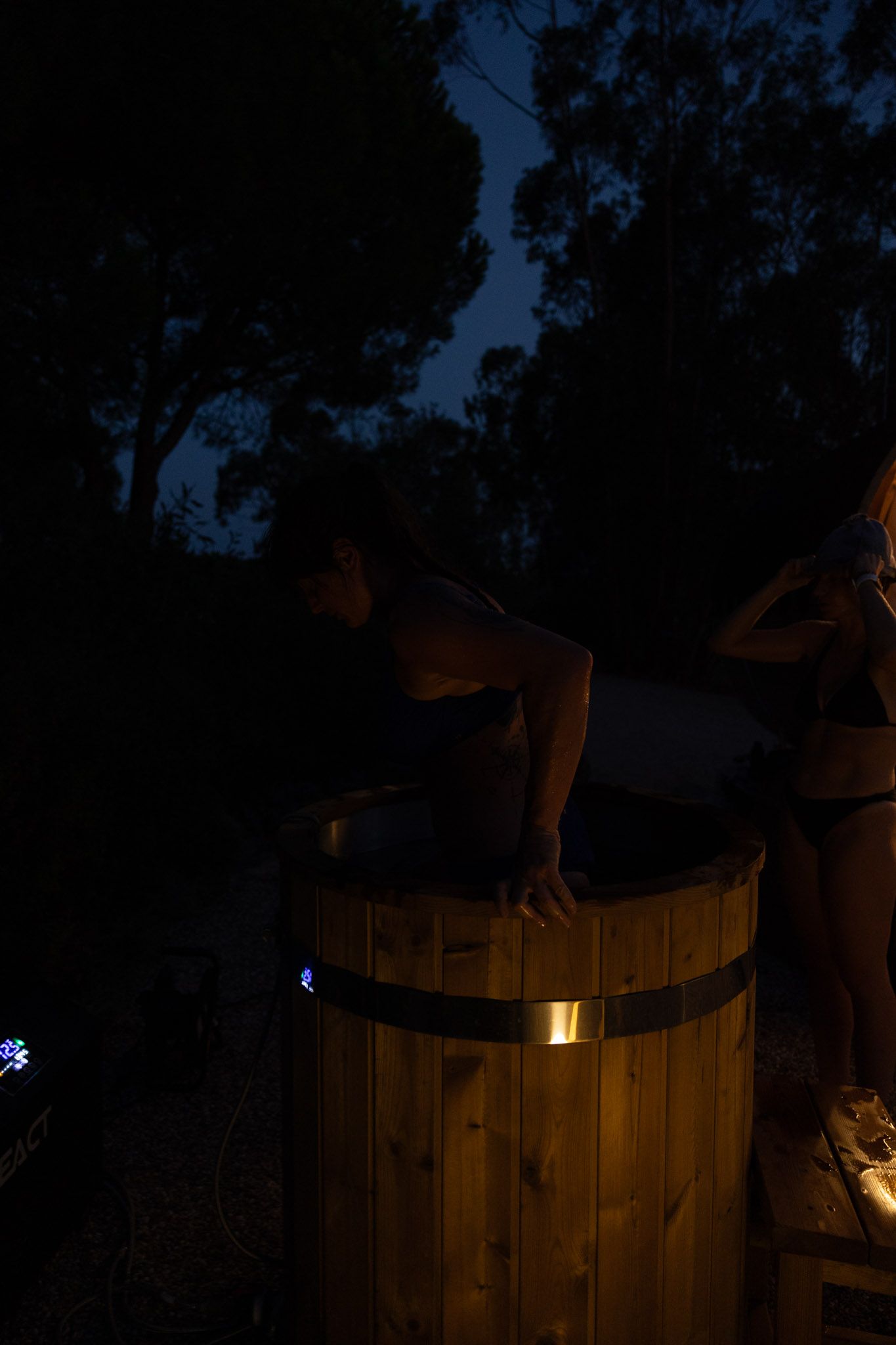
In an Atlas Cove week, heat and cold come as a dose you set for yourself, and the hour around them stays free so your hosts have time to talk with you one to one. What holds once you're home is the subject of The Return.
Common questions
Why is my heart rate higher when it's hot?
At the same pace, your heart moves a little less blood with each beat as your body warms, so it beats more often, and in warm air that rise is much larger. The most you could manage at that moment is lower as well, so the higher reading describes a genuinely harder effort.
How long does heat acclimation take?
Most of it arrives within the first week of repeated exercise in the heat, and the consensus statement puts near complete adaptation of the heart and of sweating at about six to ten days. Well-trained people tend to get there faster.
How long does heat acclimation last?
A pooled analysis found that every day without heat takes away about 2.5 percent of the gain in heart rate and core temperature, and the consensus expects most of the benefit to hold for two to four weeks. Building it back is much quicker than building it the first time.
Does a sauna after training improve endurance?
In trained runners, about half an hour of sauna after training, three sessions a week over three weeks, lowered heart rate and core temperature in a heat test and raised VO2 max in a cool one. It's a smaller dose of the stimulus you get from training in the heat, and in another study a hot bath after exercise did a similar job.
Does heat training help in cool weather?
Sometimes. One well-known study found gains in a cool room and several careful ones found none, so I count heat tolerance as the reliable return and anything in the cool as a possible extra.
Sources
-
González-Alonso, J., Teller, C., Andersen, S. L., Jensen, F. B., Hyldig, T., & Nielsen, B. (1999). Influence of body temperature on the development of fatigue during prolonged exercise in the heat. Journal of Applied Physiology, 86(3), 1032-1039. DOI: 10.1152/jappl.1999.86.3.1032
-
Coyle, E. F., & González-Alonso, J. (2001). Cardiovascular drift during prolonged exercise: new perspectives. Exercise and Sport Sciences Reviews, 29(2), 88-92. DOI: 10.1097/00003677-200104000-00009
-
Wingo, J. E., Ganio, M. S., & Cureton, K. J. (2012). Cardiovascular drift during heat stress: implications for exercise prescription. Exercise and Sport Sciences Reviews, 40(2), 88-94. DOI: 10.1097/JES.0b013e31824c43af
-
Racinais, S., Alonso, J. M., Coutts, A. J., Flouris, A. D., Girard, O., González-Alonso, J., Hausswirth, C., Jay, O., Lee, J. K. W., Mitchell, N., Nassis, G. P., Nybo, L., Pluim, B. M., Roelands, B., Sawka, M. N., Wingo, J., & Périard, J. D. (2015). Consensus recommendations on training and competing in the heat. British Journal of Sports Medicine, 49(18), 1164-1173. DOI: 10.1136/bjsports-2015-094915
-
Lorenzo, S., Halliwill, J. R., Sawka, M. N., & Minson, C. T. (2010). Heat acclimation improves exercise performance. Journal of Applied Physiology, 109(4), 1140-1147. DOI: 10.1152/japplphysiol.00495.2010
-
Kirby, N. V., Lucas, S. J. E., Armstrong, O. J., Weaver, S. R., & Lucas, R. A. I. (2021). Intermittent post-exercise sauna bathing improves markers of exercise capacity in hot and temperate conditions in trained middle-distance runners. European Journal of Applied Physiology, 121(2), 621-635. DOI: 10.1007/s00421-020-04541-z
-
Hussain, J., & Cohen, M. (2018). Clinical effects of regular dry sauna bathing: a systematic review. Evidence-Based Complementary and Alternative Medicine, 2018, 1857413. DOI: 10.1155/2018/1857413
-
Haghayegh, S., Khoshnevis, S., Smolensky, M. H., Diller, K. R., & Castriotta, R. J. (2019). Before-bedtime passive body heating by warm shower or bath to improve sleep: a systematic review and meta-analysis. Sleep Medicine Reviews, 46, 124-135. DOI: 10.1016/j.smrv.2019.04.008
-
Daanen, H. A. M., Racinais, S., & Périard, J. D. (2018). Heat acclimation decay and re-induction: a systematic review and meta-analysis. Sports Medicine, 48(2), 409-430. DOI: 10.1007/s40279-017-0808-x
-
Karlsen, A., Racinais, S., Jensen, M. V., Nørgaard, S. J., Bonne, T., & Nybo, L. (2015). Heat acclimatization does not improve VO2max or cycling performance in a cool climate in trained cyclists. Scandinavian Journal of Medicine & Science in Sports, 25(Suppl 1), 269-276. DOI: 10.1111/sms.12409
-
Keiser, S., Flück, D., Hüppin, F., Stravs, A., Hilty, M. P., & Lundby, C. (2015). Heat training increases exercise capacity in hot but not in temperate conditions: a mechanistic counter-balanced cross-over study. American Journal of Physiology - Heart and Circulatory Physiology, 309(5), H750-H761. DOI: 10.1152/ajpheart.00138.2015
-
Périard, J. D., Racinais, S., & Sawka, M. N. (2015). Adaptations and mechanisms of human heat acclimation: applications for competitive athletes and sports. Scandinavian Journal of Medicine & Science in Sports, 25(Suppl 1), 20-38. DOI: 10.1111/sms.12408
-
Scoon, G. S., Hopkins, W. G., Mayhew, S., & Cotter, J. D. (2007). Effect of post-exercise sauna bathing on the endurance performance of competitive male runners. Journal of Science and Medicine in Sport, 10(4), 259-262. DOI: 10.1016/j.jsams.2006.06.009
-
Zurawlew, M. J., Walsh, N. P., Fortes, M. B., & Potter, C. (2016). Post-exercise hot water immersion induces heat acclimation and improves endurance exercise performance in the heat. Scandinavian Journal of Medicine & Science in Sports, 26(7), 745-754. DOI: 10.1111/sms.12638
This is an educational and strategic perspective, not personal medical advice.
The views are the author's own and not statements by Atlas Cove Lda.
Tom Wuerden · Co-Founder
Engineer turned Ironman
Read next
What does it take to host a longevity retreat? Nine lessons from our September residency
What hosting our September residency at Casas na Ferraria taught me: the breaks we forgot to plan, why one-on-ones matter most, the phone-free week our guests loved, and what we have changed.
Does menopause change your metabolism? What happens to muscle, fat and blood sugar
In menopause the scale often stays on course while fat gain speeds up and muscle falls. What the evidence shows, what helps with sleepless nights, and what we saw in a week.
What happens at a six-day longevity retreat? Notes from the first Atlas Cove cohort
How the first week actually ran: the outline of a day, why one session reached some people and passed others by, and what changes next time.