
The short version
Atlas Cove runs on measurement and evidence, but the guest never sees a screen: readings are taken on day one and day six, read by our own analysis system on our own server, and turned into a week by two people who know the guest. Tracking alone moves health only a little; the gap is translation and a person to hold you to it.
For most of my adult life I have tracked my health. Sleep, resting heart rate, how well I had recovered overnight, later blood work and body composition. I liked the ritual of checking, and a good morning score felt like a small compliment before the day began.
It changed very little. I knew more every year and did roughly the same things. That gap, between knowing and doing, is the reason Atlas Cove exists, and it is why we built the residency the way we did: data driven, evidence backed, tech enabled and human led. Those four words get used loosely in this industry, so this article says what each one means for us, what it means for you as a guest, and why the guest never sees any of it.
The short version
Information was never the problem. Most of us already know what would help; the numbers alone rarely change behaviour.
Data driven means we measure you on the first morning and the last, with the same instruments, and we publish what we find honestly.
Evidence backed means every part of the week traces to a study we can name, and we say how strong that study is.
Tech enabled means the analysis runs on a system we built ourselves, on our own server, because your health data is sensitive.
Human led means the system informs and two people decide, with you, across a table.
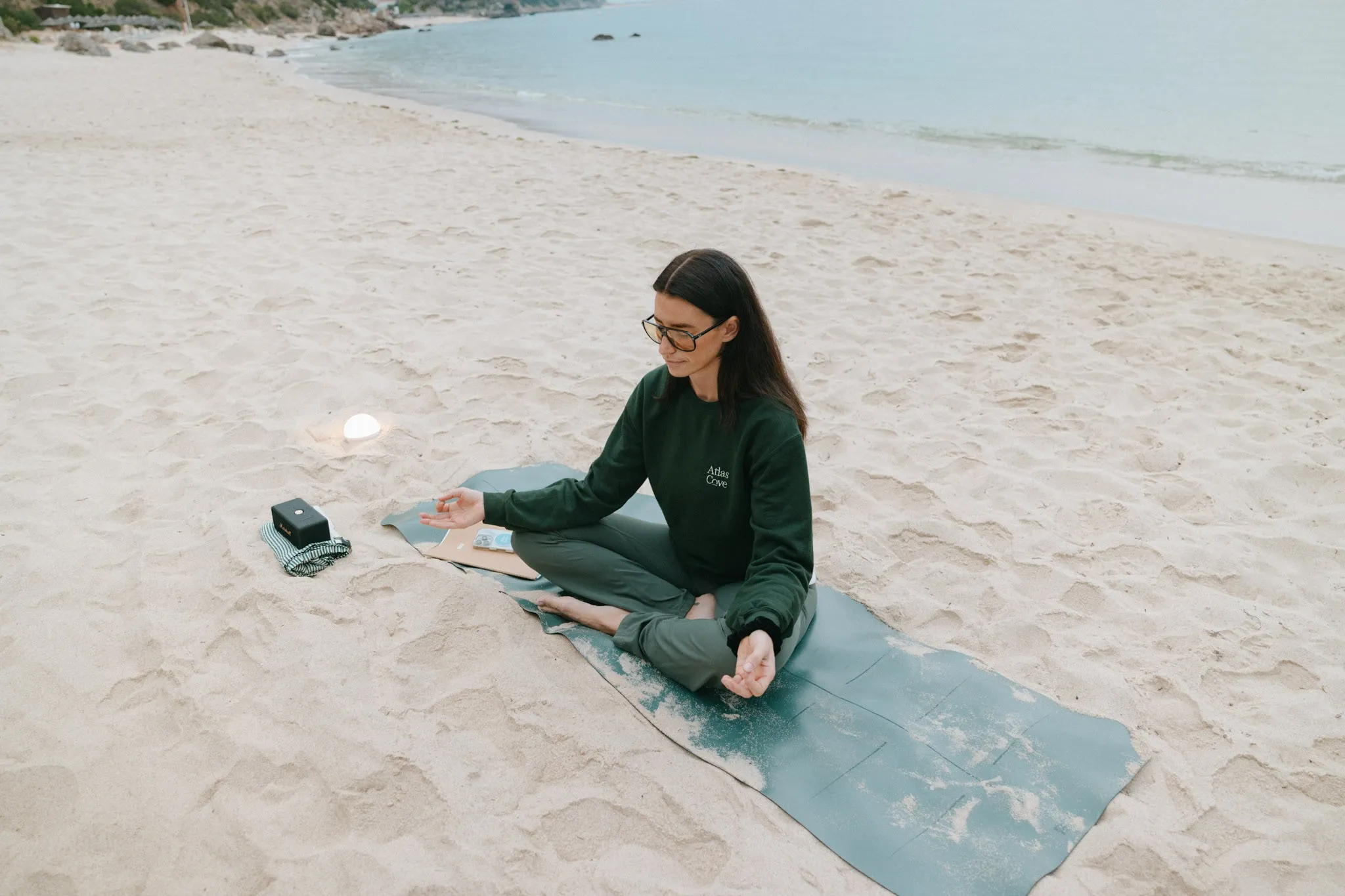
You see none of the technology. The phones go away, the shared spaces are screen free, and the week is the sea, early nights and time for your mind.
Tracking is not the same as changing
Wearables work, a little. The largest review of the evidence, a 2022 umbrella review in The Lancet Digital Health covering 39 systematic reviews and about 164,000 people, found that activity trackers raised physical activity by roughly 1,800 steps a day, about 40 minutes of walking, and took about a kilogram off body weight over the studies' average of five months. Effects on other health outcomes were small and mostly not significant.
That is a real benefit and I would not argue against it. It is also a modest one, set against a world in which, by the WHO's 2024 estimate, 31% of adults do not reach the recommended 150 minutes of moderate activity a week, five points worse than in 2010. The watches have never been more widespread. The trend has gone the other way.
I read that as evidence for something I had already felt. The missing piece is not more information. It is translation, and a person to hold you to it. A reading only matters if someone turns it into a decision, and a decision only holds if someone is there when it gets hard.
Data driven: measured on day one and day six
Every guest arrives with a validated wellbeing scale already completed. On the first morning we take grip strength, blood pressure, body composition and VO2 max. Sleep and blood pressure are taken daily. On the last morning we take the same readings again, same instruments, same hour.
Grip strength is the one people are most surprised by. In the PURE study, published in The Lancet in 2015, grip was measured in about 140,000 adults across 17 countries, and every five kilograms less grip went with a 16% higher rate of death over the follow-up. It predicted that better than systolic blood pressure did. It is an association, and the authors say so, but it is a strong one, and grip takes thirty seconds to measure and responds to training within weeks.
In September, every guest left with a stronger grip; five of seven cleared the day-to-day drift of the instrument, with the largest gain 9.9 kg. Overnight heart rate variability rose for every guest across the week. Four of the five who repeated the wellbeing scale scored measurably better. A cohort of seven is an early signal, and we say so every time we quote it. I wrote more about that week in what it takes to host a longevity retreat.
What data driven means for you: the week ends with your own numbers, not an impression. You know what moved, by how much, and what to measure again in twelve weeks.
Evidence backed: one shared rhythm, set to your numbers
We do not build a different programme for each guest. We run one rhythm that the evidence supports most strongly, coached strength, time in the sea, heat and cold, meals cooked on the estate, early nights, and we adjust the intensity of each unit to the individual. Tom set out the evidence on the training side in how much strength training you need after 40; the short answer is far less than most people assume, if the set ends hard.
Evidence backed means something specific to us. Every element of the week traces to a named study, we say what kind of study it is, and we describe the evidence exactly as strong as it is. Where the literature is uncertain, we say that too. In a category where the established houses speak the language of clinical authority, our authority has to come from being right and honest about the limits.
What it means for you: nothing in the week is there because it photographs well or because someone's intuition said so. You can ask why any part of it exists, and we can answer with a source.
Would you like a week built on your own measurements? Every residency starts with an Alignment Call, so we know the week is right for you before anything is booked. Apply for a place.
Tech enabled: our own system, on our own server
Behind the week sits an analysis system Tom and I built ourselves. It takes the readings, the scales and the daily sleep and blood pressure data and turns them into a picture of each guest that we read before every one-on-one. It is not a generic AI and it is not a wearable dashboard. It runs on our own server because health data is the most sensitive data a person has, and we did not want it on anyone else's.
It also keeps us honest. The system flags what moved and what did not, so the conversation on day six is about the numbers rather than how everyone felt about the week.
What it means for you: the analysis is ours and the data is yours. It is not sold, not shared, and not used to train anything.
Human led: the system informs, we decide
This is the layer I care about most, and it is the one most easily lost when a business discovers what software can do.
The honest reading of the research is mixed. Several meta-analyses find that human support raises adherence to digital health programmes, while a 2023 meta-analysis in Psychosomatic Medicine found that self-help eHealth programmes did about as well as human-supported ones for people with cardiometabolic risk. So I will not claim that a person is always better than a screen. I will claim something narrower from what we saw in September: what guests valued above everything else was the hour sitting down with their own numbers and their own questions, with someone who knew them. We have since rebuilt the afternoons to make room for more of it.
At Atlas Cove the system never decides. Tom and I read what it shows, sit with each guest, and work out together what the numbers mean in a life that has a calendar, a family and a job in it. Then we agree what goes home: a short list of tools that fit that life, not a protocol that fits a spreadsheet. That is the Personalised Health Toolbox, and it is the only deliverable of the week.
What it means for you: you are read by people, not scored by a programme. And you leave with a plan two humans will recognise you by when you write in March.
Why you will see none of this
Here is the part that surprises people. All of that technology exists so that the guest never has to look at any of it.
On arrival we strongly encourage you to hand your phone to the team; we run a phone service for loved ones and work, and if you need it you use it in your room. The shared spaces are screen free. There is no dashboard on the wall, no app to check, no number to chase between sessions. What there is: the coast at first light, a coached session on the deck, the sauna and the sea, a long table at dusk, lights out at nine, and two people who know your numbers and your reasons.
We built it this way on purpose. The information was never the problem. Being told what to do by a screen, in a week that is supposed to give your mind a rest, would be the problem. So the data runs the week quietly, from behind, and you get the silence. In September our guests chose the phone-free week without being asked twice, and it was the thing they talked about most afterwards.
What this is, in one breath
Up to ten rooms. Measured on day one and day six. Every protocol traced to a study. A system we built ourselves, that no guest ever sees. Five nights without a screen, with the sea, early nights and time for your mind. Two people across the table who know your numbers and your reasons.
Most retreats offer rest. A few offer measurement. Very few offer both, in a group this small, with the numbers kept out of sight. That combination is what we set out to build, because it is what I wished had existed for me.
Dates and room rates for every upcoming cohort are on the apply page. Apply for a place.
What this article can and cannot tell you
The tracker and inactivity figures are population averages from a 2022 umbrella review and a 2024 WHO analysis. Your own response to a tracker may be larger or smaller.
Grip strength predicts mortality in cohort data. That is an association. Improving grip has not been shown in a trial to lengthen life; it has been shown to improve function.
The evidence on human support is mixed, and our September observations come from seven guests. We will keep measuring with every cohort and report what we find.
Questions people often ask
Do I need to bring a wearable or an app?
No. We take every measurement ourselves with our own instruments. If you wear a device at home, you are welcome to keep it on; it plays no part in the week.
Who sees my data?
Lisa and Tom, on a system we built and run on our own server. It is not shared with third parties or used to train anything.
Is Atlas Cove a clinic?
No. Atlas Cove provides health strategy and lifestyle coaching. We do not practise medicine, diagnose or prescribe. Where a clinical need shows up in the numbers, we connect guests with trusted specialists.
Can I keep my phone?
Yes, though we strongly encourage you not to. Guests who hand it in use the team's phone service for anything urgent.
Sources
Ferguson T et al. Effectiveness of wearable activity trackers to increase physical activity and improve health: a systematic review of systematic reviews and meta-analyses. The Lancet Digital Health, 2022.
Strain T et al. National, regional, and global trends in insufficient physical activity among adults from 2000 to 2022. The Lancet Global Health, 2024.
Leong DP et al. Prognostic value of grip strength: findings from the Prospective Urban Rural Epidemiology (PURE) study. The Lancet, 2015.
Cohen Rodrigues TR et al. Effectiveness of human-supported and self-help eHealth lifestyle interventions for patients with cardiometabolic risk factors: a meta-analysis. Psychosomatic Medicine, 2023.
This is an educational and strategic perspective, not personal medical advice.
Lisa Wuerden · Co-Founder
Co-founder, brand and product
Read next
Does stress change how you make decisions? What a month of pressure does to the thinking brain, and how quickly it comes back
A month of ordinary pressure loosens the brain network that plans and chooses. A month of less pressure restores it. What the evidence says, and why we built the week around the quiet.
How much strength training do you need after 40? Minimum effective dose and what to measure
Most of what lifting gives you arrives in the first 40 to 60 minutes a week. What cohort curves, minimal-dose trials and volume studies show.
How much protein do you need after 40? Anabolic resistance and the per-meal dose
After 40 the muscle builds less from the same meal. What anabolic resistance is, why the dose per meal matters, and what a hard session changes.